Research

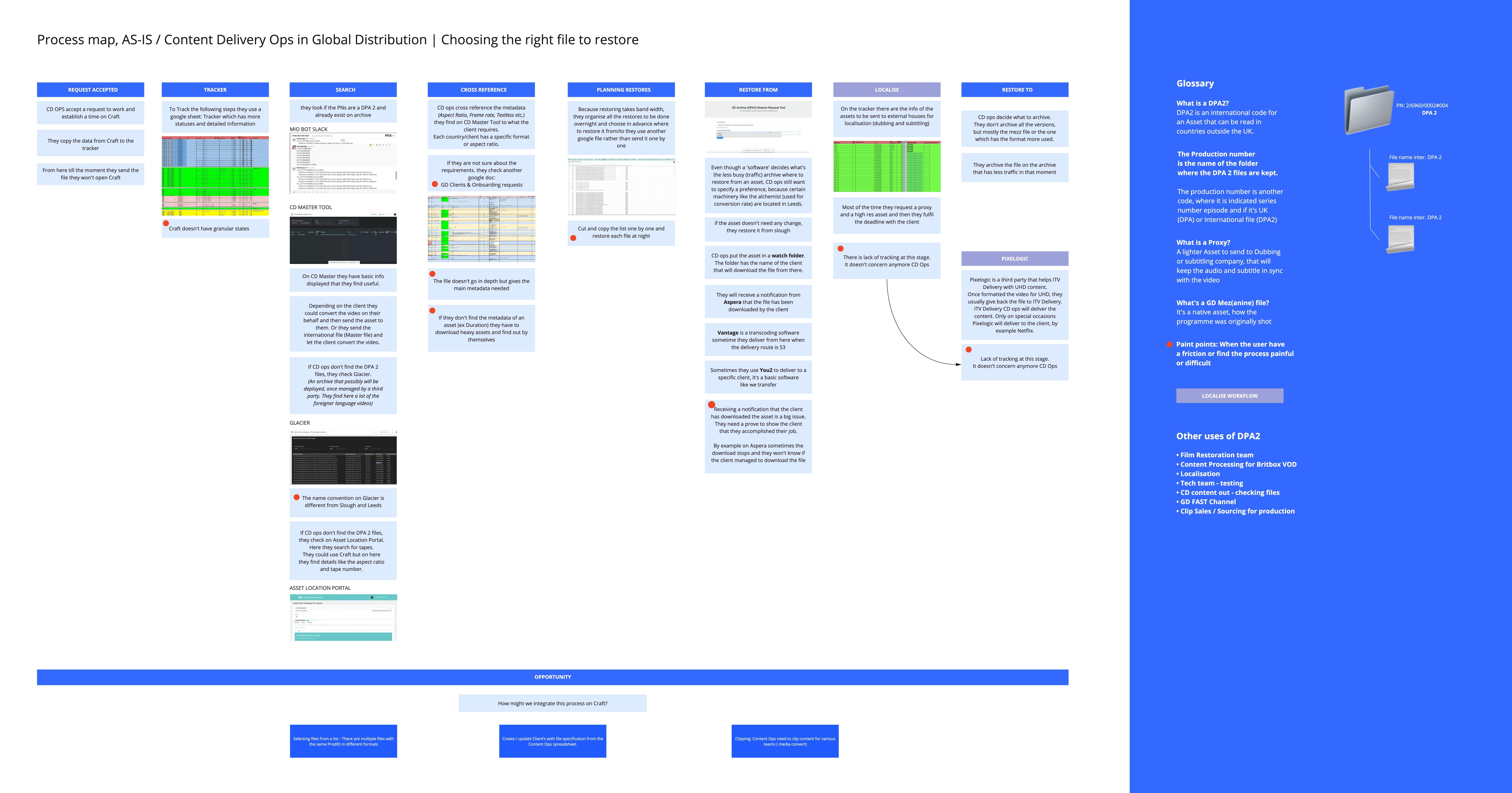
Once mapped their work process from request to delivery, I discovered that most of the difficulties were related to the delivery of an asset. Choosing the right asset and bespoking the asset to the client's requests relied heavily on human decision and experience.
WORKSHOP
RESEARCH
STRATEGY
UX/UI DESIGN
USABILITY TESTING
Opportunity
So we saw an opportunity: "expand" Craft capabilities, cutting down other software and Google Sheets and "centralise" all the data on Craft, reducing operational time, error rates and inaccuracy in the data.
Craft is an internal tool for delivering and tracking media assets sent to UK or international broadcasts.
The Challenge
ITV’s global media distribution faced inefficiencies: Due to the long history of ITV archives, searching for assets in a vast, complex archive was slow and error-prone. Multiple tools and manual processes created fragmentation and high operational costs.
FIRST STEP
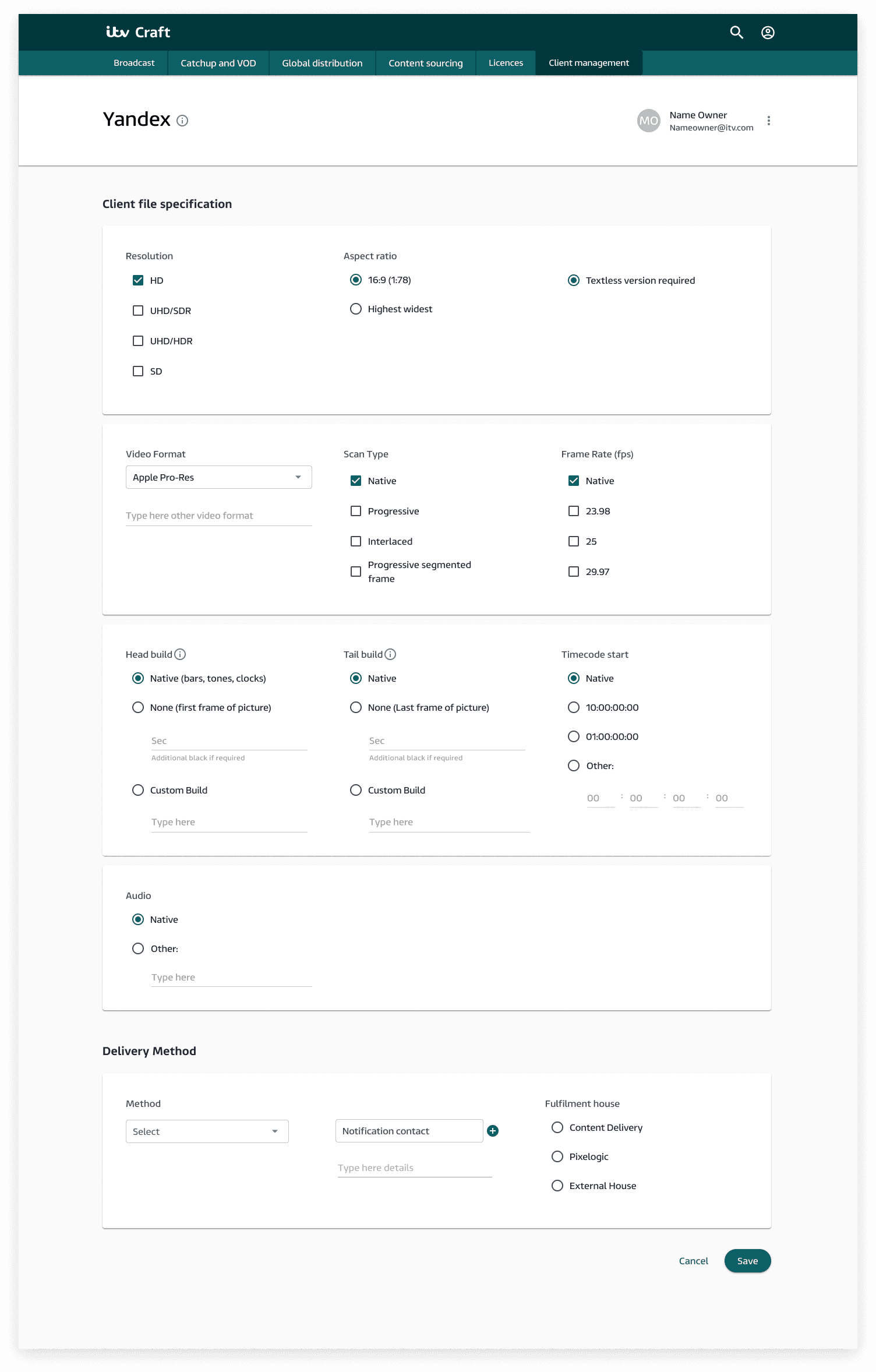
Make Craft a source of truth for client technical specs and delivery to ensure that all teams have access to the same information.
SECOND STEP
Make all content searchable and reusable for different productions on Craft. Show the metadata of the original assets in the archive when possible.
THIRD STEP
Whenever possible, automate the delivery of assets to the client.
Client Management
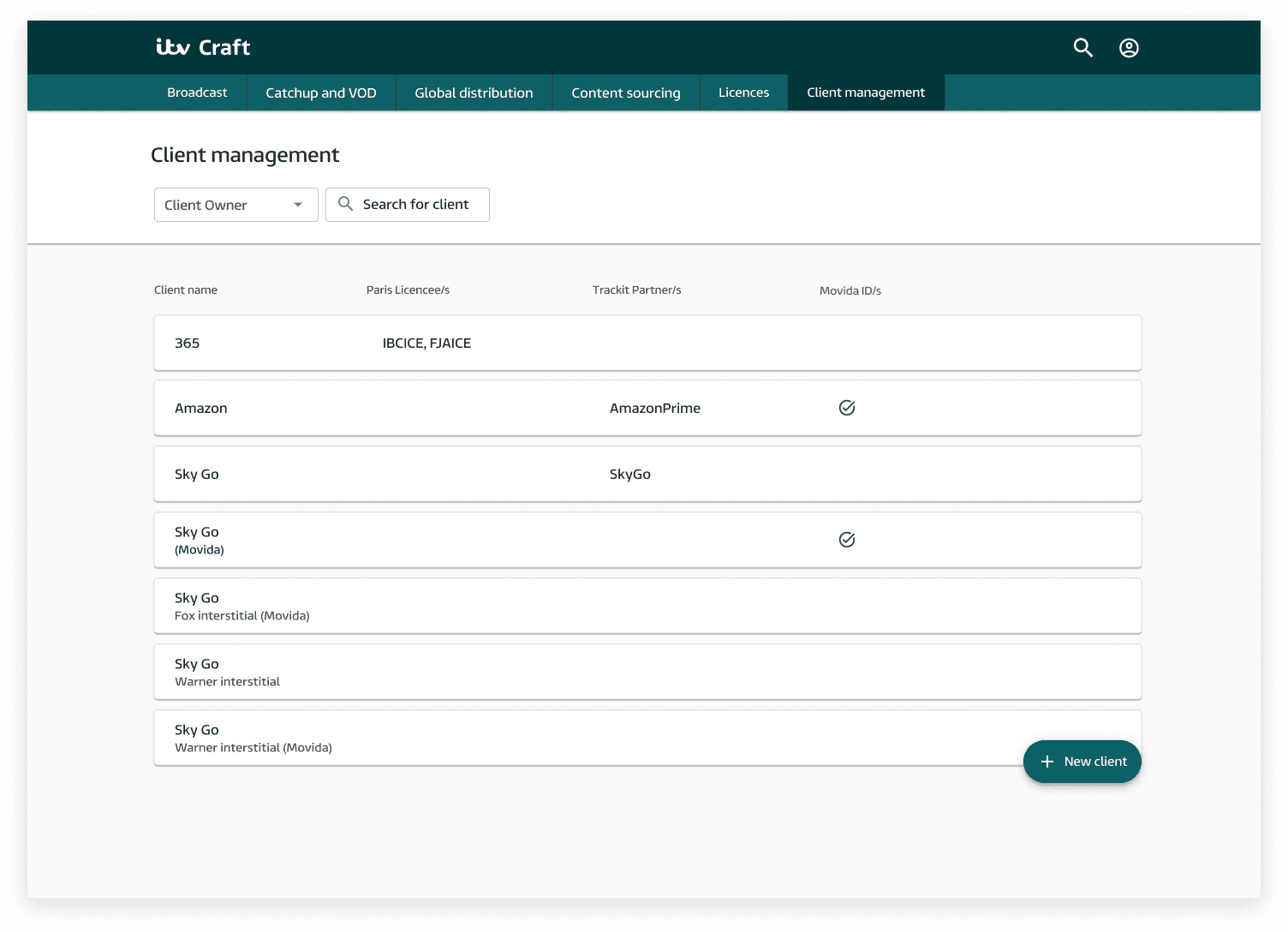
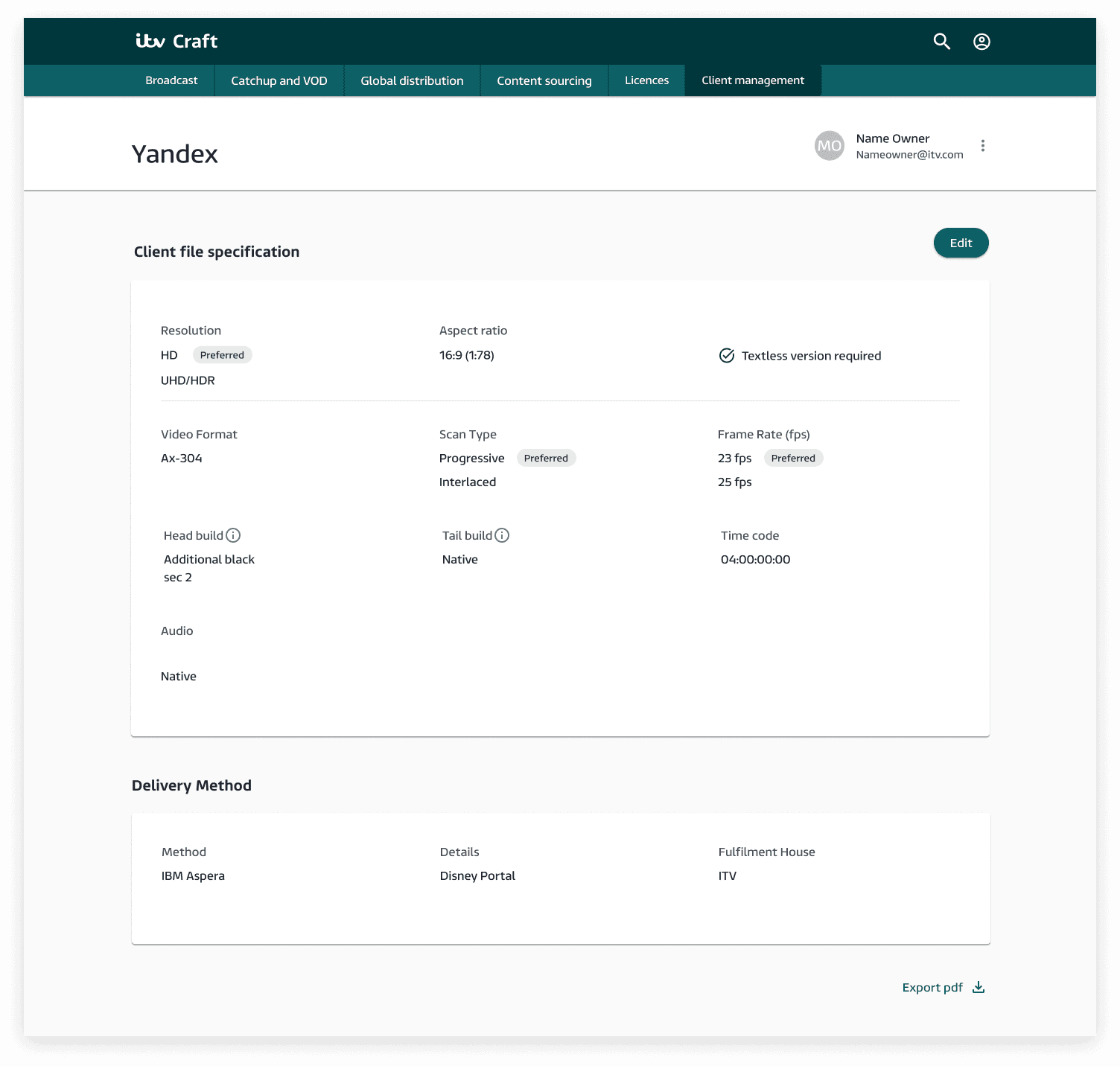
To achieve these steps, we decided to expand an existing section of the website called Client Management, which was a list of clients with basic information. Then, for the first prototype, I conducted more specific research, which involved collecting all the existing documents, onboarding emails sent to the clients, and qualitative research to understand the main criteria to choose an asset, followed by moderated usability testing.
The prototype was iterated twice. The users found it more complete, easier and faster to fill in. The Google Sheets used to keep track of the client specs were discharged.
To note: the design system used for all the software in ITV was changed to meet the triple A standard for accessibility.

Finding the right assets
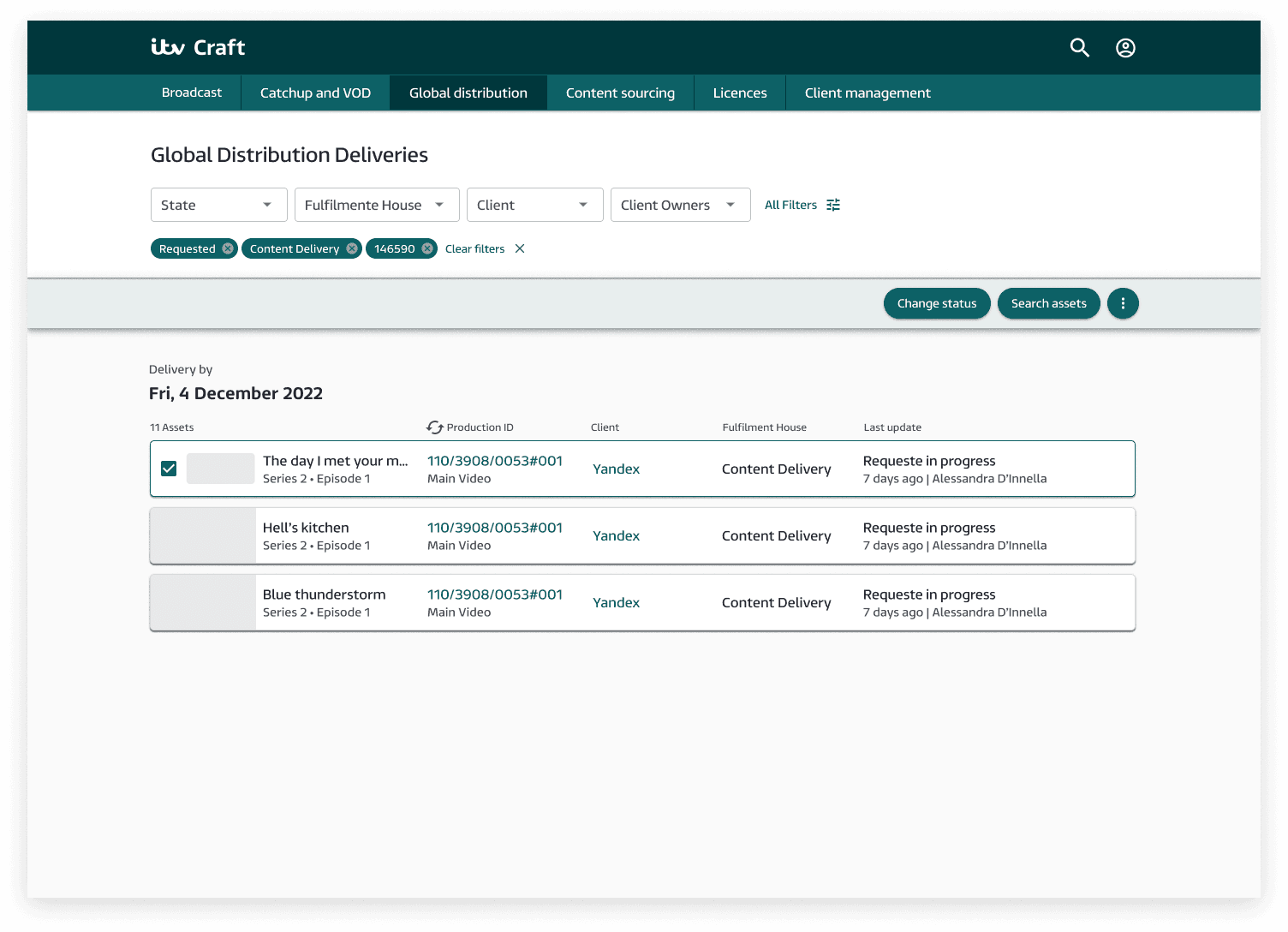
Once Client Management started working on Craft and the ‘database’ was growing, we moved to the next step, to make assets searchable.
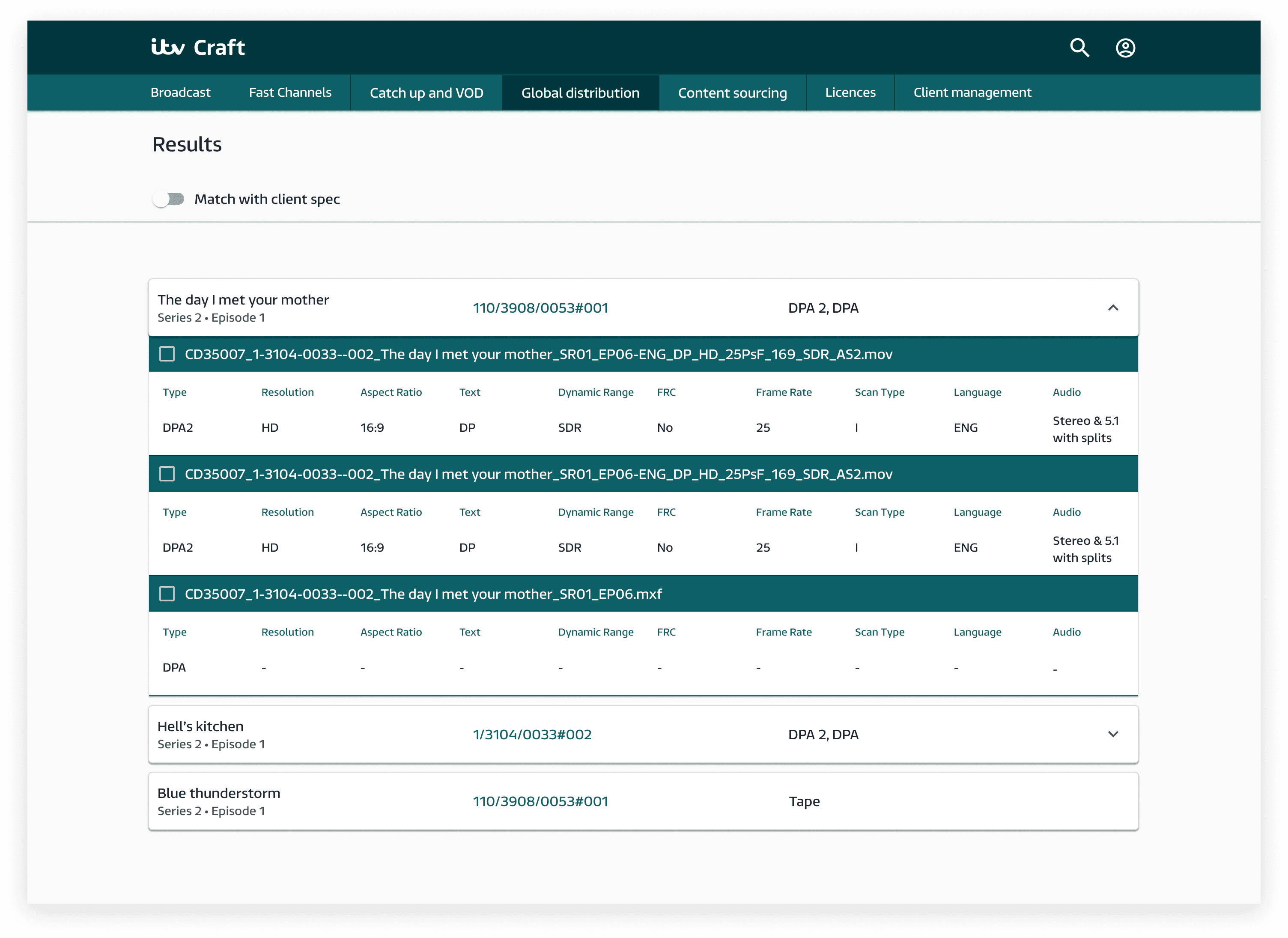
Drawing from the previous research, I designed and then conducted usability tests on a search feature on the Global Distribution dashboard.
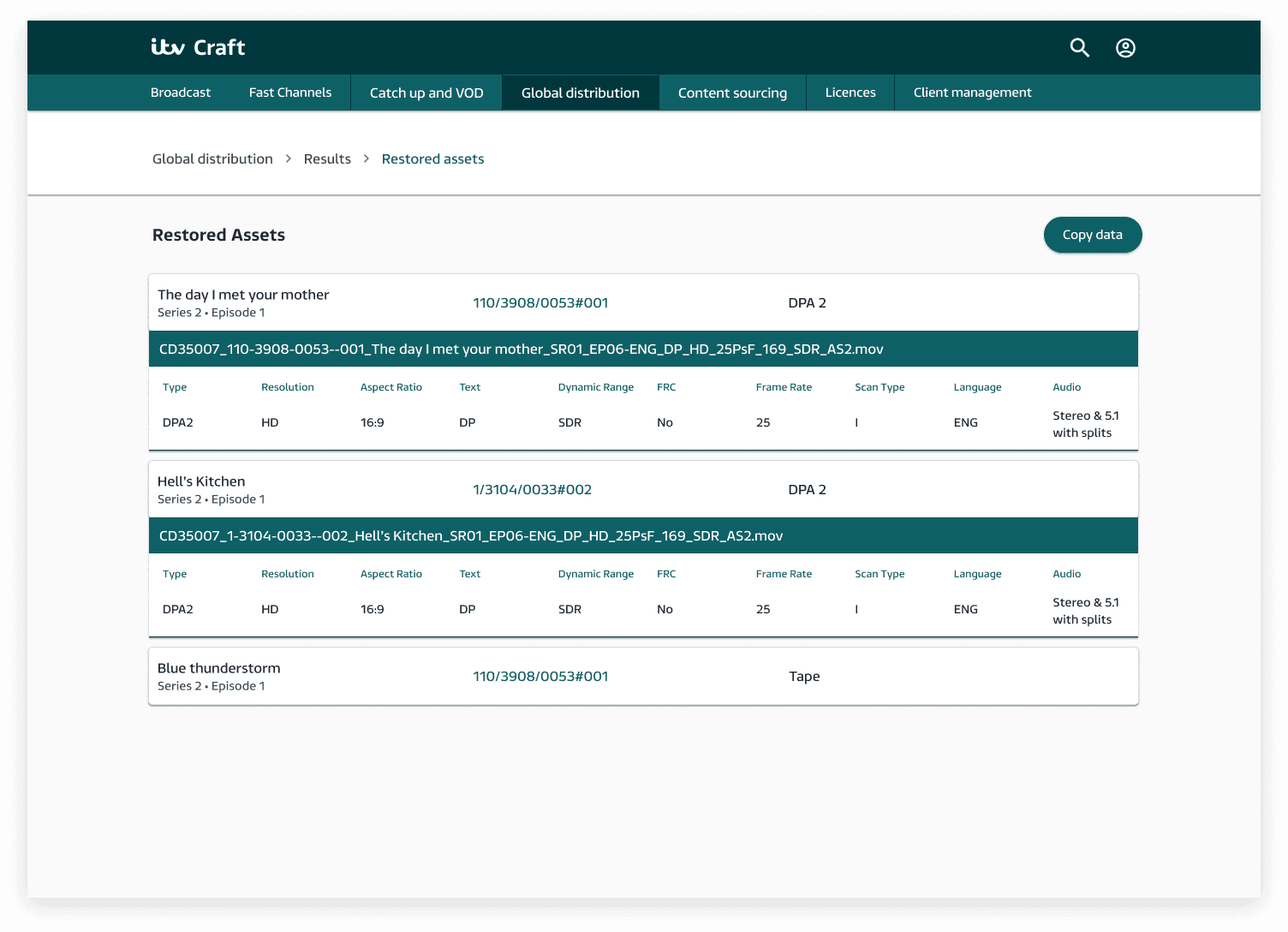
The initial idea in the prototype was to let the automation choose the closest existing asset to the client specification, but once finished the usability tests, I added a switch so that the user could decide if trust ‘the automated choice’ or not.
Results
At the moment ITV archives count 43.000 assets, so far we automated the search of 17.000 assets and the delivery of 85% on the last number.
That resulted on a 30% reduction of operational time in Global distribution.
What I did
As the only product designer embedded within ITV's 6-person agile team, I was tasked with deeply understanding user needs and identifying strategic opportunities to enhance workflows, balancing user and business objectives. This included creating new features and automating large parts of the process for tracking and distributing media internationally. That involved extensive research, planning, and rigorous usability testing.
Craft is an internal tool for delivering and tracking media assets sent to UK or international broadcasts.
WORKSHOP
RESEARCH
STRATEGY
UX/UI DESIGN
USABILITY TESTING
WORKSHOP
RESEARCH
STRATEGY
UX/UI DESIGN
USABILITY TESTING
WORKSHOP
RESEARCH
STRATEGY
UX/UI DESIGN
USABILITY TESTING
What I did
As the only product designer embedded within ITV's 6-person agile team, I was tasked with deeply understanding user needs and identifying strategic opportunities to enhance workflows, balancing user and business objectives. This included creating new features and automating large parts of the process for tracking and distributing media internationally. That involved extensive research, planning, and rigorous usability testing.
The Challenge
ITV’s global media distribution faced inefficiencies: Due to the long history of ITV archives, searching for assets in a vast, complex archive was slow and error-prone. Multiple tools and manual processes created fragmentation and high operational costs.
Research
Once mapped their work process from request to delivery, I discovered that most of the difficulties were related to the delivery of an asset. Choosing the right asset and bespoking the asset to the client's requests relied heavily on human decision and experience.
Opportunity
So we saw an opportunity: "expand" Craft capabilities, cutting down other software and Google Sheets and "centralise" all the data on Craft, reducing operational time, error rates and inaccuracy in the data.
FIRST STEP
Make Craft a source of truth for client technical specs and delivery to ensure that all teams have access to the same information.
SECOND STEP
Make all content searchable and reusable for different productions on Craft. Show the metadata of the original assets in the archive when possible.
THIRD STEP
Whenever possible, automate the delivery of assets to the client.
Client Management
To achieve these steps, we decided to expand an existing section of the website called Client Management, which was a list of clients with basic information. Then, for the first prototype, I conducted more specific research, which involved collecting all the existing documents, onboarding emails sent to the clients, and qualitative research to understand the main criteria to choose an asset, followed by moderated usability testing.
The prototype was iterated twice. The users found it more complete, easier and faster to fill in. The Google Sheets used to keep track of the client specs were discharged.
To note: the design system used for all the software in ITV was changed to meet the triple A standard for accessibility.
Finding the right assets
Once Client Management started working on Craft and the ‘database’ was growing, we moved to the next step, to make assets searchable.
Drawing from the previous research, I designed and then conducted usability tests on a search feature on the Global Distribution dashboard.
The initial idea in the prototype was to let the automation choose the closest existing asset to the client specification, but once finished the usability tests, I added a switch so that the user could decide if trust ‘the automated choice’ or not.
Results
At the moment ITV archives count 43.000 assets, so far we automated the search of 17.000 assets and the delivery of 85% on the last number.
That resulted on a 30% reduction of operational time in Global distribution.
Craft is an internal tool for delivering and tracking media assets sent to UK or international broadcasts.
Craft is an internal tool for delivering and tracking media assets sent to UK or international broadcasts.
WORKSHOP
RESEARCH
STRATEGY
UX/UI DESIGN
USABILITY TESTING
What I did
As the only product designer embedded within ITV's 6-person agile team, I was tasked with deeply understanding user needs and identifying strategic opportunities to enhance workflows, balancing user and business objectives. This included creating new features and automating large parts of the process for tracking and distributing media internationally. That involved extensive research, planning, and rigorous usability testing.
The Challenge
ITV’s global media distribution faced inefficiencies: Due to the long history of ITV archives, searching for assets in a vast, complex archive was slow and error-prone. Multiple tools and manual processes created fragmentation and high operational costs.
Research
Once mapped their work process from request to delivery, I discovered that most of the difficulties were related to the delivery of an asset. Choosing the right asset and bespoking the asset to the client's requests relied heavily on human decision and experience.
Opportunity
So we saw an opportunity: "expand" Craft capabilities, cutting down other software and Google Sheets and "centralise" all the data on Craft, reducing operational time, error rates and inaccuracy in the data.
FIRST STEP
Make Craft a source of truth for client technical specs and delivery to ensure that all teams have access to the same information.
SECOND STEP
Make all content searchable and reusable for different productions on Craft. Show the metadata of the original assets in the archive when possible.
THIRD STEP
Whenever possible, automate the delivery of assets to the client.
Client Management
To achieve these steps, we decided to expand an existing section of the website called Client Management, which was a list of clients with basic information. Then, for the first prototype, I conducted more specific research, which involved collecting all the existing documents, onboarding emails sent to the clients, and qualitative research to understand the main criteria to choose an asset, followed by moderated usability testing.
The prototype was iterated twice. The users found it more complete, easier and faster to fill in. The Google Sheets used to keep track of the client specs were discharged.
To note: the design system used for all the software in ITV was changed to meet the triple A standard for accessibility.

Finding the right assets
Once Client Management started working on Craft and the ‘database’ was growing, we moved to the next step, to make assets searchable.
Drawing from the previous research, I designed and then conducted usability tests on a search feature on the Global Distribution dashboard.
The initial idea in the prototype was to let the automation choose the closest existing asset to the client specification, but once finished the usability tests, I added a switch so that the user could decide if trust ‘the automated choice’ or not.
Results
At the moment ITV archives count 43.000 assets, so far we automated the search of 17.000 assets and the delivery of 85% on the last number.
That resulted on a 30% reduction of operational time in Global distribution.